- United States (USD $)
 Best Sellers


 All products
 Shop by category


 Bundles
✦
Help me choose
Take the quiz [1 min.]
Bundles
✦
Help me choose
Take the quiz [1 min.]

How to Teach Your Kids to Express Their Feelings Confidently
Give your children the words they need to understand their emotions and ask for what they need clearly.

>
>
TL;DR
-
Build childhood emotional literacy through daily habit.
-
Replace overwhelming meltdowns with intentional conversation.
-
Give kids vocabulary for healthy expression.
-
Strengthen family mental health and connection.
How can I teach my kids to talk about their big feelings confidently?
To teach children to express their feelings confidently, parents must provide a structured emotional vocabulary paired with a safe, judgment-free environment for daily practice. Moving past superficial questions allows families to co-create healthy emotional habits that transform overwhelming internal states into clear, actionable communication. Validating their vulnerability while modeling open communication directly fosters lifelong resilience and emotional intelligence.

Overcoming the Silence: The Core Challenge of Childhood Emotions
Many parents watch their children struggle under the weight of big emotions without knowing how to intervene. When a child experiences frustration, anxiety, or sadness, those internal states frequently manifest outwardly as emotional outbursts, sudden withdrawal, or total defiance. The underlying issue is rarely a desire to misbehave; rather, it stems from a fundamental lack of psychological vocabulary required to translate physiological sensations into spoken words.
When children do not possess the precise tools for talking about feelings, they default to behavioral expressions that strain parent-child bonds and create a chaotic home environment. Without an intentional framework, daily stressors quickly compound into long-term barriers to positive family mental health.
★★★★★ 1M+ happy customers
Our best conversation starters for romantic questions for couples

The Long-Term Cost of Repressed Communication
When these early communication gaps are left unaddressed, the downstream consequences ripple across a child’s entire developmental trajectory. A child who cannot articulate envy or fear at home will struggle significantly with playground drama, potentially leading to social isolation or academic avoidance.
Over time, recurring communication breakdowns teach children that their emotional internal world is either too dangerous or too complex to share with others. This realization breeds deep-seated patterns of emotional repression, directly hindering the development of core emotional intelligence in kids during their most formative years. The resulting psychological distance leaves parents feeling like helpless referees in their own households, entirely disconnected from the vibrant internal lives of their growing children.
A Gentle, Low-Friction Path Forward
True behavioral transformation requires moving away from defensive reactions and moving toward a proactive, low-friction solution that normalizes psychological vulnerability. Helping a child develop lifelong emotional literacy does not demand intense, hour-long therapeutic interventions; instead, it flourishes through structured, playful routines that remove the intimidation from sensitive conversations. By integrating targeted, open-ended prompts into your natural family rhythms, you remove the defensive pressure and allow children to explore their internal landscapes safely. This structured vulnerability gently shifts the family dynamic away from defensive policing, unlocking an authentic path toward how to build lasting trust and strong family connections while quietly cultivating a supportive home environment.
A Lifesaver for Meltdowns
"Our seven-year-old used to completely shut down or throw massive tantrums whenever he felt frustrated by schoolwork. Introducing these structured reflection prompts completely changed our evenings, giving him the exact vocabulary he needed to say 'I'm feeling overwhelmed' instead of exploding."
Latisha O
Connected on a Deeper Level
"I always worried that my quietest child was hiding her anxieties from me because she never responded to standard questions. Using these gentle, low-pressure conversation starters opened the floodgates, revealing a deeply creative, emotionally insightful girl who just needed a safe runway to speak."
Sharon L
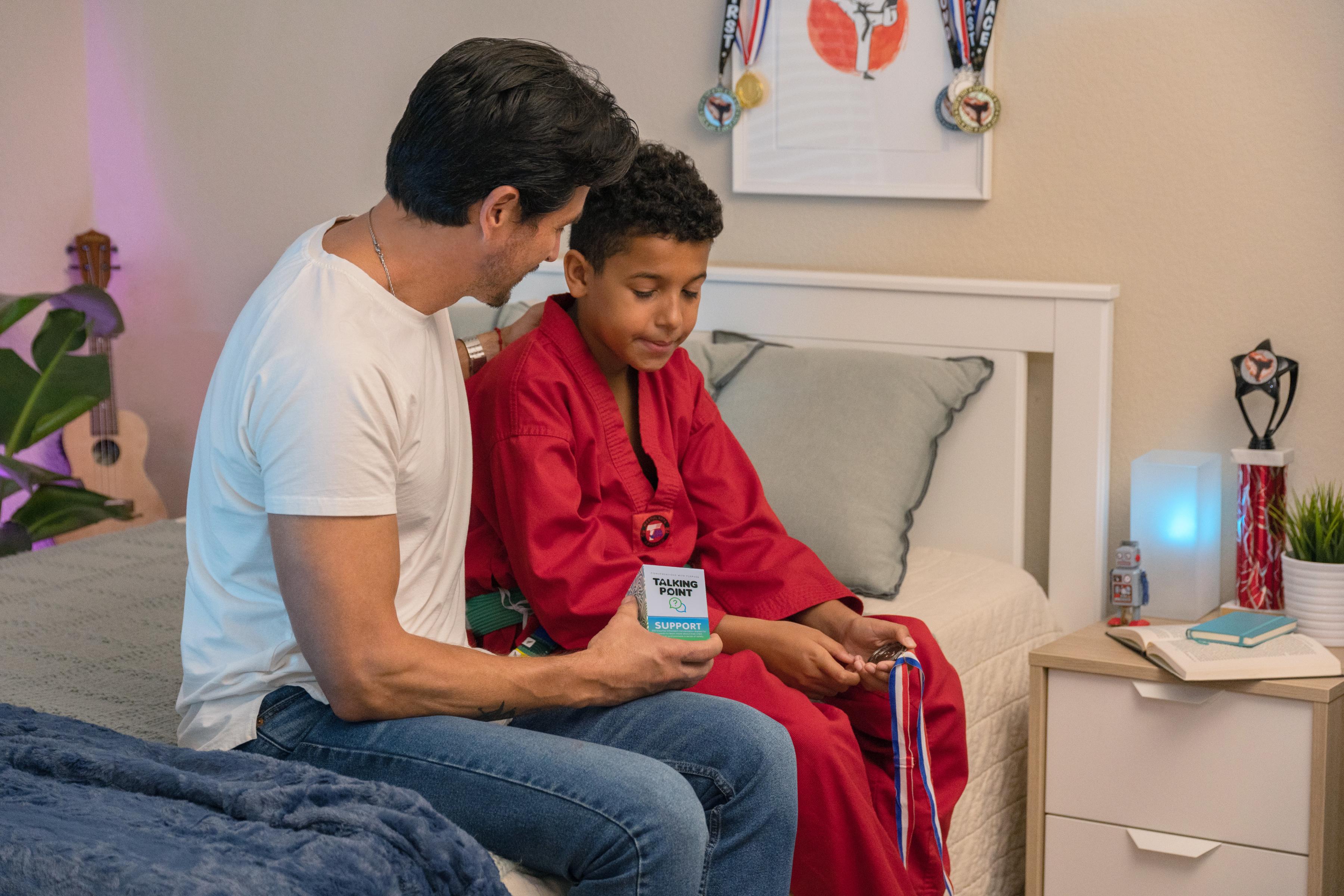
Secure Creative Confidence at Home
You do not have to navigate the exhausting cycle of childhood meltdowns and silent walls alone. By transforming abstract emotional concepts into an engaging, structured family routine, you can actively equip your children with the foundational communication skills they need to thrive out in the real world. Secure your deck of Talking Point Cards: Support today to replace stressful domestic friction with deep, meaningful family validation.
Frequently asked questions
60-day hassle-free returns
Ready to give Talking Point Cards a try? We think you’ll love them, but if not, you’ve got 60 days to return them for free.